
The Golden Moon of Audarya
Can a human being be regarded as being god-like, say, as an avatar, in the present day and age? Sanatana dharma clearly specifies three minimum conditions for someone to be regarded and revered as god-incarnate: first, Shastra Pramana, references from scriptures; second, specific auspicious symbols on the physical body of that person; and third, the 32 bodily characteristics found in such an individual.
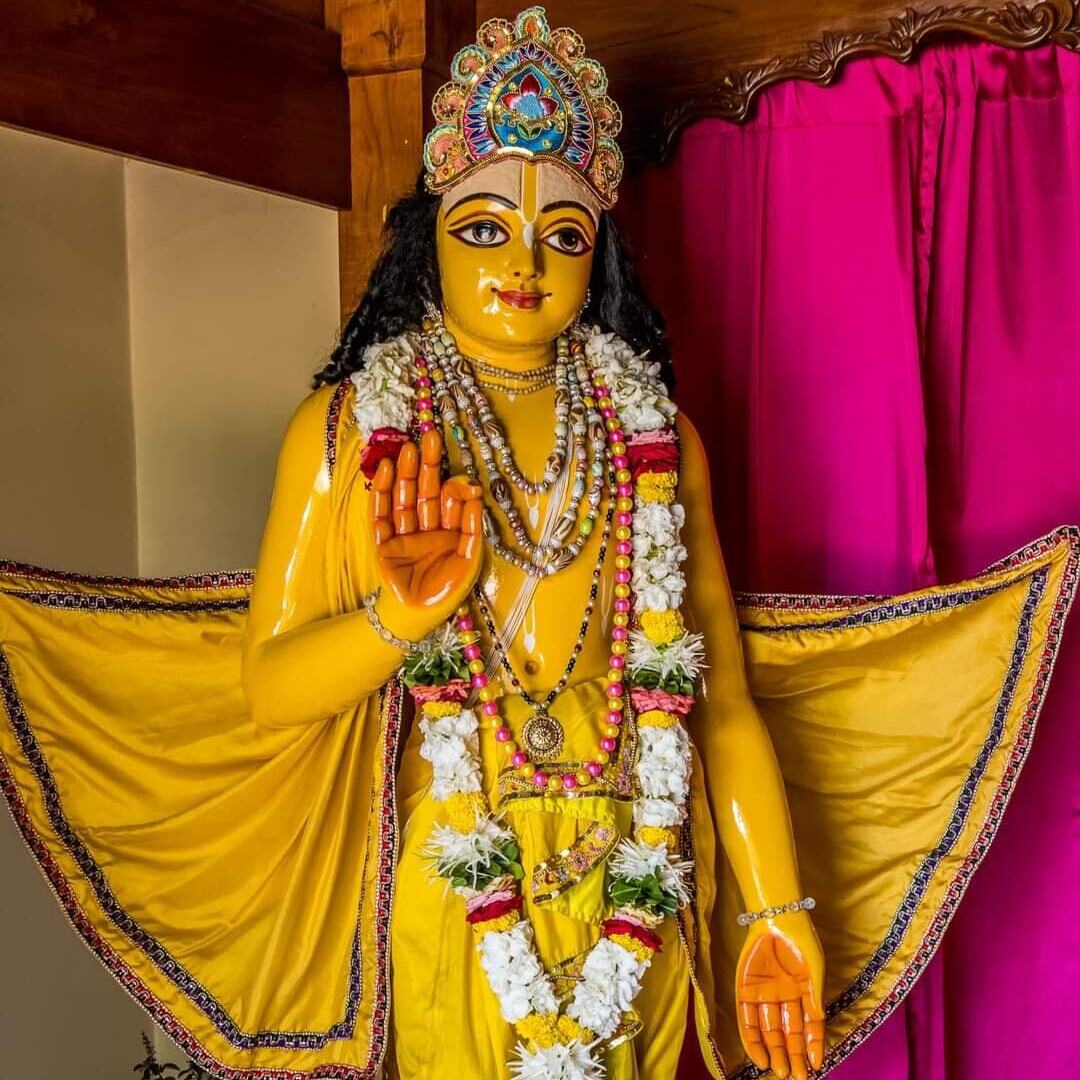
Vaishanvaites regard Chaitanya Mahaprabhu who appeared in West Bengal at Mayapur, Nabadwip in 1486, on the day of Falguni Purnima as the most recent incarnation of god. He is regarded as a great saint from Bengal who inaugurated the Sankirtana Movement and propagated the chanting of the Hare Krishna mahamantra. But when we refer to the scriptures, we find that his identity has been ascertained as the original supreme personality of godhead, more exalted, perhaps, than even an avatar. A verse in the Garuda Purana says, “In the first part of Kaliyuga, I will appear in my complete spiritual form in Mayapura, Navadvipa and become the son of Sachi.”
Another verse from the Garuda Purana describes his complexion, gives the name of his wife, describes his life of renunciation and gives information about his residence and other details. “In the first part of Kaliyuga, the Supreme with golden complexion, will become the husband of Lakshmi. Then he will become a sannyasi and reside near Jagannatha.”
It’s quite possible that this evidence can be refuted if it’s only coming from one Purana. But more than 10 clear references are there about Chaitanya Mahaprabhu’s birth, parentage, activities and philosophy in the Srimad Bhagavatam, Narada Purana, Bhavishya Purana, Narasimha Purana, Padma Purana, Skanda Purana, Vayu Purana and Vishnu Sahasranamam from Mahabharata.
1. Mahābhārata (Dāna-dharma Parva)
सुवर्णवर्णो हेमाङ्गो
वराङ्गश्चन्दनाङ्गदी ।
संन्यासकृच्छमः शान्तो
निष्ठाशान्तिपरायणः ॥
Translation:
“The Supreme Lord will appear with a golden complexion and a beautiful form, adorned with sandalwood paste. He will accept the renounced order of life and remain peaceful, self-controlled, and devoted to spiritual realization.”
2. Nārada Purāṇa
कलौ सङ्कीर्तनारम्भे
भविष्यामि शचीसुतः ॥
Translation:
“In the age of Kali, I shall appear as the son of Śacī-devī and inaugurate the saṅkīrtana movement.”
3. Padma Purāṇa
अहमेव क्वचिद् ब्रह्मन्
संन्यासाश्रममाश्रितः ।
हरिभक्तिं ग्राहयामि
कलौ पापहतान् नरान् ॥
Translation:
“O brāhmaṇa, in the age of Kali I shall accept the renounced order of life and teach devotion to Lord Hari, delivering people who are destroyed by sin.”
4. Bhaviṣya Purāṇa
आनन्दनाम्नि नगरे
भविष्ये शचीसुतः ।
गौररूपो महात्मा
महाभागवतः प्रभुः ॥
Translation:
“In a city called Ānanda (Navadvīpa), I shall appear as the son of Śacī-devī, in a golden form, as a great soul and a great devotee of the Lord.”
5. Caitanya Upaniṣad (Atharva Veda)
गौरः सर्वात्मा महान्
भगवान् चैतन्यरूपी ।
कलौ सङ्कीर्तनारम्भे
भविष्यामि शचीसुतः ॥
Translation:
“The Supreme Lord, the Supersoul of all, will appear in a golden form as Śrī Caitanya. In the age of Kali, He will inaugurate the saṅkīrtana movement as the son of Śacī-devī.”
Purpose of Lord's descent
Endowed with the golden complexion and deep emotions of Śrīmatī Rādhārāṇī, He descended with three confidential purposes:
To give the rarest gift – without condition, without qualification
1. To give what was never given before – highest mādhurya-prema
(Caitanya-caritāmṛta, Ādi-līlā 1.4)
Sanskrit:
अनर्पितचरिं चिरात् करुणया अवतीर्णः कलौ
समर्पयितुम् उन्नतोज्ज्वलरसां स्वभक्तिश्रियम् ।
हरिः पुरटसुन्दरद्युतिकदम्बसन्दीपितः
सदा हृदयकन्दरे स्फुरतु वः शची-नन्दनः ॥
Translation:
“May Śrī Śacī-nandana, the Supreme Lord Hari, who has descended in the age of Kali out of compassion, eternally manifest in your heart. He has come to bestow the most elevated mellow of devotional service—unnatojjvala-rasa (conjugal love)—which was never given before.”
2. To taste Śrīmatī Rādhārāṇī’s love
(Caitanya-caritāmṛta, Ādi-līlā 1.5)
स्वयं भगवान् कृष्ण
राधिका-प्रेम-रासः ।
आपेक्षितुम् अभिलषन्
गौररूपेण जातः ॥
Translation:
“The Supreme Lord Śrī Kṛṣṇa, who is the embodiment of divine rasa, desired to taste the love of Śrīmatī Rādhārāṇī. Thus He appeared in a golden form.”
(Caitanya-caritāmṛta, Ādi-līlā 1.6)
श्रीराधायाः प्रणयमहिमा कीदृशो वानयैव
स्वाद्यो येनाद्भुतमधुरिमा कीदृशो वा मदीयः ।
सौख्यं चास्याः मदनुभवतः कीदृशं वेति लोभात्
तद्भावाढ्यः समजनि शचीगर्भसिन्धौ हरिन्दुः ॥
Translation:
“Desiring to understand the glory of Śrī Rādhā’s love, the wonderful sweetness that He experiences through that love, and the happiness She feels upon realizing His sweetness, the Supreme Lord Hari appeared from the womb of Śacī-devī, enriched with Her emotions.”
3. To deliver the fallen souls of Kali-yuga through nāma-saṅkīrtana
(Śrīmad Bhāgavatam 11.5.32)
कृष्णवर्णं त्विषाकृष्णं
साङ्गोपाङ्गास्त्रपार्षदम् ।
यज्ञैः सङ्कीर्तनप्रायैः
यजन्ति हि सुमेधसः ॥
Translation:
“In the age of Kali, intelligent persons worship the Supreme Lord by the sacrifice of congregational chanting. He chants the name of Kṛṣṇa, is of golden complexion, and is accompanied by His associates.”
Auspicious symbols on Lord's body
1. Thirty-two Major and Sixty-four Minor Marks of a Mahāpuruṣa
(Caitanya-caritāmṛta, Madhya-līlā 20.352)
द्वात्रिंशल्लक्षणं देहे
चतुःषष्ट्यनुलक्षणम् ।
सर्वाङ्गे शोभते यत्र
तं वै महापुरुषं विदुः ॥
Translation:
“One whose body displays the thirty-two major symptoms and sixty-four secondary symptoms of a great personality is known as a mahāpuruṣa. All these auspicious marks were manifest on the transcendental body of Śrī Caitanya Mahāprabhu.”
2. Marks of Conch, Disc, Club and Lotus on His Hands and Feet
(Caitanya-bhāgavata, Ādi-khaṇḍa 2.22–23)
शङ्खचक्रगदापद्म
लक्षणानि करे पदे ।
श्रीगौराङ्गस्य दृश्यन्ते
भक्तानां हृदयानि हृत् ॥
Translation:
“The auspicious marks of the conch, disc, club, and lotus were visible on the hands and feet of Śrī Gaurāṅga Mahāprabhu, captivating the hearts of His devotees.”
3. Lotus, Flag, Thunderbolt and Fish on the Soles of His Feet
(Caitanya-bhāgavata, Ādi-khaṇḍa 2.31–32)
ध्वजवज्राङ्कुशाम्भोज
मत्स्यरेखाश्च पादयोः ।
गौरचन्द्रस्य दृश्यन्ते
लोकमङ्गलहेतवः ॥
Translation:
“On the soles of Lord Gauracandra’s feet were seen the signs of the flag, thunderbolt, goad, lotus, and fish—symbols that bring auspiciousness to all the worlds.”
4. Golden Complexion and Radiance Like Molten Gold
(Śrīmad Bhāgavatam 11.5.34)
यदा पश्यः पश्यते रुक्मवर्णं
कर्तारमीशं पुरुषं ब्रह्मयोनिम् ।
Translation:
“When one sees the golden-colored Supreme Lord, the original creator and supreme controller…”
Rukma-varṇa indicates Mahāprabhu’s golden hue, one of the most prominent auspicious signs.
5. Eyes Like Blooming Lotuses and Long Beautiful Arms
(Caitanya-bhāgavata, Ādi-khaṇḍa 2.15)
पद्मायताक्षो दीर्घबाहुः
कम्बुग्रीवो मनोहरः ।
नवयौवनसंयुक्तो
गौरः प्रेमप्रदायकः ॥
Translation:
“Śrī Gaurāṅga had lotus-like eyes, long arms, a conchshell-like neck, and an enchanting youthful form. Thus He appeared as the golden giver of divine love.”
7. Hair, Voice, and Gait Marked by Divine Excellence
(Caitanya-caritāmṛta, Ādi-līlā 3.16)
सिंहग्रीवो महाबाहुः
गम्भीरस्वरसंयुतः ।
सर्वलक्षणसम्पन्नो
भक्तानां प्राणवल्लभः ॥
Translation:
“With the neck of a lion, mighty arms, and a deep, resonant voice, the Lord was endowed with all auspicious features and was the very life of His devotees.”